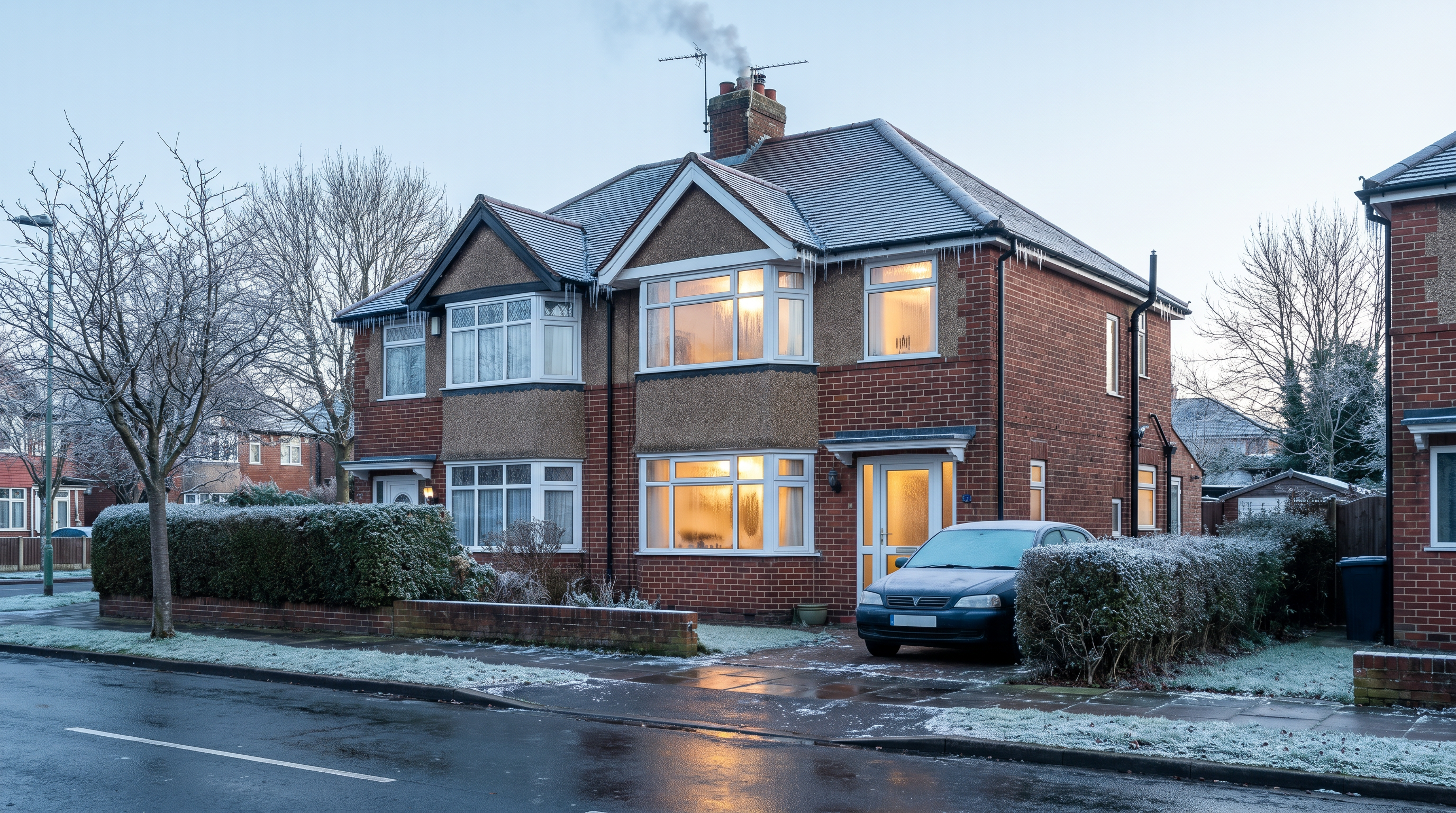
If you live in a 1920s or 1930s semi, you probably already know the pattern. The house has charm, presence, and proportions that many newer homes struggle to match, yet every cold spell seems to prove the same point: it costs far too much to heat.
Rooms can feel chilly even with the heating running, the temperature can drop quickly once the boiler stops, and winter bills can feel out of proportion to the comfort you actually get. That is not bad luck. It is usually the result of how these houses were built.
This guide explains why interwar semis are so often expensive to heat, where the heat typically escapes, and which upgrades make a real difference rather than just nibbling at the edges of the problem.
Why 1920s and 1930s semis lose so much heat.
These houses were built in an era that cared far more about durability and suburban expansion than about thermal performance. Many of them are well-built, but they are not energy efficient by modern standards.
Empty cavity walls
A lot of interwar semis have cavity walls, which sounds reassuring until you remember that the cavity is often empty. Compared with solid-wall Victorian construction, that was progress at the time, but by current expectations it still leaves a large amount of heat escaping through the wall build-up.
Poor loft insulation
Some have had loft insulation added over the years, but many still have too little, poorly laid insulation, or old material that no longer performs as it should. Because heat rises, the loft remains one of the easiest ways for warmth to disappear from the house.
Older windows, draughts, and floors
Original windows, ageing replacements, draughty doors, suspended floors, chimney leakage, and under-insulated floor sections all add to the problem. Even when each gap seems small on its own, together they create a house that struggles to hold on to warmth.
Why the bills feel so bad.
The frustrating part is not just the cost. It is the feeling that you are paying a lot without getting the result you expected. You turn the heating up, the house warms a little, and then the heat seems to vanish almost as soon as the system cycles down.
That happens because the building envelope is leaking heat faster than most owners realise. When the walls, loft, floors, windows, and draught points are all underperforming, the heating system is fighting the house rather than simply warming it.
The features that make interwar semis especially challenging.
These homes often have recurring design features that worsen heat loss and make comfort harder to achieve.
- Bay windows create extra exposed surfaces and awkward thermal weak points.
- Side walls on semis and end-of-terrace variants expose a large elevation directly to the weather.
- Mixed wall construction can leave some sections performing worse than others.
- High ceilings and older detailing can increase draught perception and heating demand.
In practice, that means these houses often feel colder than owners expect from their size alone, especially in windy weather or after dark when exposed walls cool rapidly.
What helps a little, and what helps a lot.
It is worth being realistic about priorities. Some measures are absolutely worth doing, but they mainly improve the margins. Others change the building more fundamentally and therefore produce much stronger results.
Useful supporting improvements
- Loft insulation top-ups are often quick, cost-effective wins.
- Draught-proofing windows, doors, floors, and unused chimneys improves comfort.
- Window upgrades can help, especially when old units are performing badly.
Major thermal upgrades
- Cavity wall insulation can significantly improve performance where the cavity is suitable.
- External wall insulation is often the most comprehensive route because it treats mixed wall types and improves the whole envelope.
The difference is that the major upgrades do not just reduce a draught here or a weak spot there. They change how the house retains heat overall.
Why external wall insulation is often so effective on these houses.
For many 1920s and 1930s semis, external wall insulation is one of the strongest long-term answers because it tackles a large share of the heat loss at source. It works across cavity and solid sections, improves continuity around weak points, and can also refresh a tired exterior.
- It addresses major wall heat loss rather than only treating secondary symptoms.
- It can reduce cold bridging around junctions and details.
- It preserves internal room sizes because the upgrade sits outside the house.
- It improves both performance and appearance, which can support wider value and comfort goals.
That does not mean it is the right route for every single home, but on this house type it is often one of the clearest ways to move from “always expensive and never warm enough” to a much more stable and comfortable living environment.
Where cavity wall insulation fits in.
Cavity wall insulation can be a sensible first or parallel step where the cavity is appropriate and in good condition. It is usually cheaper and less disruptive than a full external system. The trade-off is that it does not solve every weak point, especially around mixed construction, exposed details, and cold bridging.
For some homeowners, cavity insulation alone is enough to make the house feel materially better. For others, especially those facing persistent cold walls, mixed wall sections, or stronger comfort expectations, it becomes part of a broader solution rather than the whole answer.
The investment question.
Owners naturally want to know whether the numbers stack up. The answer depends on current bills, how much heat the property is losing now, and how extensive the chosen upgrade is. But the important point is that many of these homes are already costing their owners heavily year after year through avoidable heat loss.
That means the cost of doing nothing is real as well. It appears as high winter bills, colder internal surfaces, reduced comfort, and in some cases condensation or mould risk around the colder parts of the building.
How to tell if your semi is a strong candidate.
- The house is expensive to heat but never feels properly warm.
- You notice cold walls, rapid heat loss, or persistent draughts.
- There is condensation, especially near colder wall or window areas.
- The property has had piecemeal upgrades but still performs poorly overall.
If several of those points sound familiar, the house is likely not suffering from one isolated issue. It is more likely underperforming as a whole, which is why a property-level insulation strategy matters.
Our practical view.
A 1920s or 1930s semi can absolutely become much more comfortable and cheaper to run, but it rarely happens through heating tweaks alone. The lasting improvement comes from reducing the amount of heat the building loses in the first place.
That usually means starting with the obvious quick wins, then deciding whether cavity wall insulation, external wall insulation, or a combined route is the most sensible fit for the house. On many interwar semis, that decision becomes one of the most important comfort upgrades an owner can make.
What to do next.
The right next step is to assess the house properly rather than guessing from general rules. Wall type, exposed elevations, bay construction, current loft condition, existing insulation, and signs of condensation all shape the best answer.
A survey can show where your semi is losing heat most badly, which improvements should come first, and whether the strongest route is cavity fill, external wall insulation, or a more phased programme tailored to the way your property is built.
Keep researching this topic
Browse the wider archive before you make a decision.
Good blog content should narrow the question, not trap you on one page. Use the archive and category views to compare neighbouring guides, then move into service and proof pages once the direction becomes clearer.
After cost research, compare the real routes
Do not stop at price ranges. Use the service, proof, and survey pages to work out what is actually right for your house.
Cost-led readers are usually close to making a decision. The most helpful next step is to compare services clearly, then validate the likely route against real work and a property-specific survey.
Visit the external wall service page
If your questions are mainly about solid walls, rendering, finish, and deeper retrofit value, start here.
Check proof before you commit
Use real project pages to understand what finished work looks like and how homeowners judge the result beyond price alone.
Get a survey for your own property
The real answer depends on wall type, access, detailing, and what already exists on the house. The survey turns research into an informed decision.
Explore the wider journey
Useful next pages once the article makes sense.
Rockwarm now has a fuller service, proof, FAQ, and local-search structure. These pages help move from general education into comparison, reassurance, and a more confident commercial next step.
Compare the three main insulation routes side by side before choosing the wrong first spend.
See longer-form proof showing how service choice, property type, and finished outcomes fit together.
Read homeowner feedback and trust signals.
Check coverage across Coventry, Nuneaton, Birmingham, and the wider Midlands.
Free survey
Ready to move from reading to a real recommendation?
Guides can explain the possibilities, but they cannot confirm exactly what your own property needs. If you want advice based on the actual walls, loft, layout, and condition of your home, book a free survey and we will point you toward the most suitable next step, including when a simpler route makes more sense than a larger project.