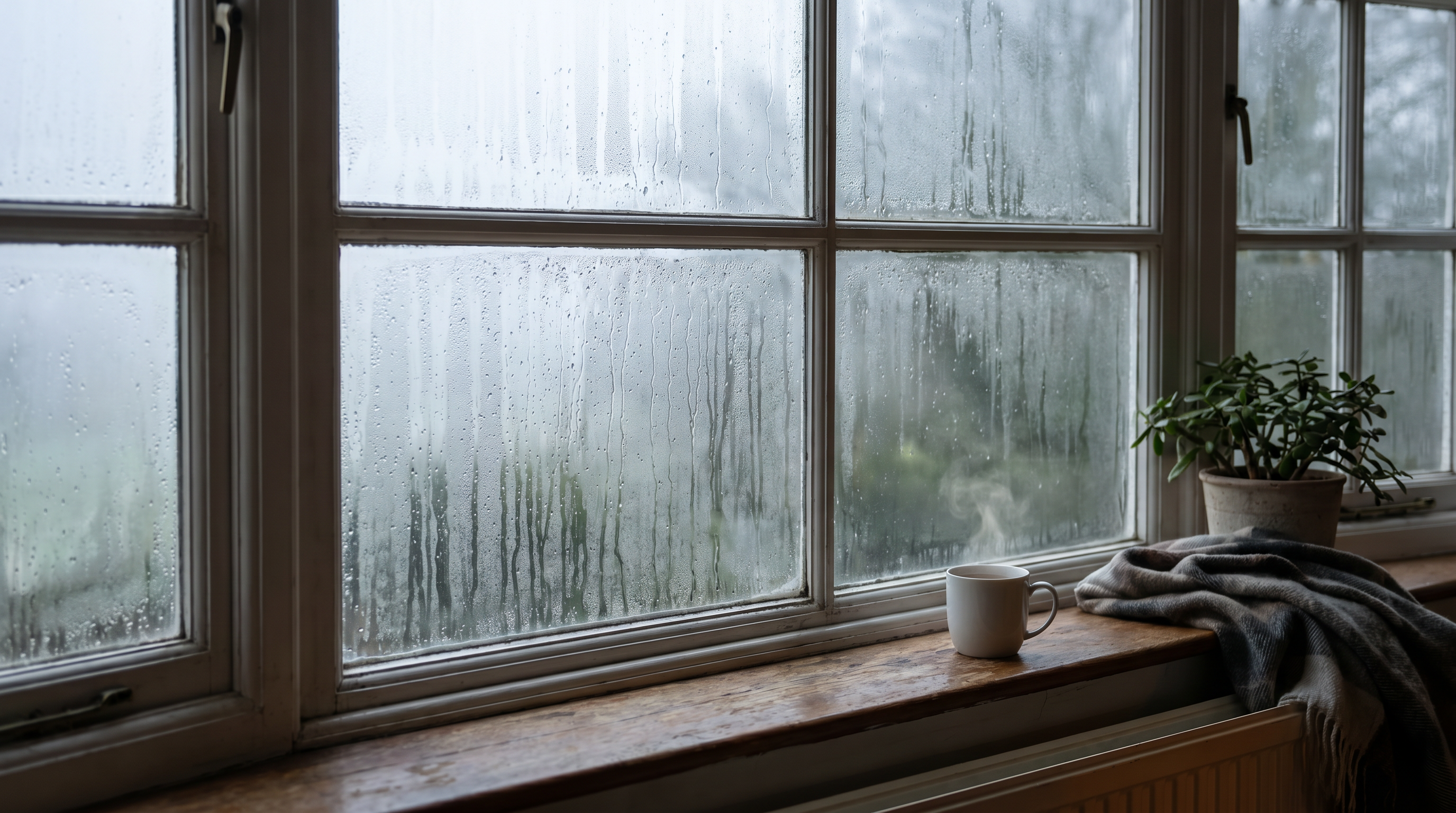
If you are wiping water from the inside of your windows every morning, it is easy to assume the glass is faulty or that the house simply needs more ventilation. In many homes, the real problem sits deeper in the building fabric.
Persistent window condensation usually appears where the home is already losing heat badly. The glass shows the symptom first, but the cause is often cold surrounding surfaces, especially uninsulated external walls.
That is why people can replace windows, open vents, or buy a dehumidifier and still wake up to streaming glass. They are treating the visible surface, not the cold conditions making condensation happen in the first place.
What is actually happening when water runs down the glass.
Condensation forms when warm moist air meets a cold surface and the moisture in that air turns back into liquid water. Windows usually show this first because glass cools down quickly and is often the coldest visible surface in the room.
The important point is that the window is not necessarily the source of the problem. It is simply where the imbalance between warm indoor air and cold internal surfaces becomes easiest to see.
Why cold walls and window condensation are connected.
When external walls are uninsulated or thermally weak, they stay cold even after the heating has been on for hours. That cools the air around the perimeter of the room, makes window reveals and adjacent surfaces colder, and creates the perfect conditions for condensation.
- Cold walls pull heat out of the room air near them.
- Windows set into those cold walls are surrounded by colder surfaces.
- Warm moist air from everyday living then meets those cold surfaces and turns to water.
This is why window condensation is often part of a bigger pattern. The same homes frequently have cold external walls, colder corners, musty smells, and recurring mould in the places that never seem to dry out properly.
Why new windows often fail to solve it.
Replacing windows can improve glazing performance, but it does not automatically make the surrounding walls warm. If the room still has cold external surfaces, condensation can continue on the glass, around the frame, or in nearby corners. That is why some homeowners spend heavily on new windows and still end up wiping water away every morning.
A quick way to test whether cold walls are part of the issue.
Put your hand on an external wall, especially near the room with the worst condensation. If it feels noticeably colder than an internal partition wall, even after the heating has been running, that is a strong sign the house is losing heat through the fabric and creating cold surface conditions indoors.
Then look at the pattern. Is the condensation worst on windows set into outside-facing walls? Do corners or reveals also feel damp? If the answer is yes, you are probably dealing with a cold-wall problem as much as a moisture problem.
What actually fixes the cause.
If cold walls are driving the issue, the long-term fix is to make those surfaces warmer. That means improving the insulation performance of the building envelope rather than trying to manage condensation indefinitely after it appears.
External wall insulation
For many older solid-wall homes, external wall insulation is the strongest route because it adds a continuous insulating layer around the outside of the property. That helps internal wall surfaces stay warmer, reduces cold spots around windows, and makes condensation much less likely to form.
Ventilation still matters
Ventilation is still part of the picture, because homes need a sensible way to remove everyday moisture from cooking, bathing, drying clothes, and normal occupation. But ventilation alone does not fully solve a house with chronically cold walls. The most reliable outcome comes from combining adequate ventilation with better thermal performance.
Dehumidifiers are only a holding measure
A dehumidifier can reduce moisture in the air for as long as it keeps running, but it does not explain why the room surfaces are cold enough to attract condensation so easily. It is useful as a temporary measure, not as the main answer.
Why mould often follows window condensation.
Where there is persistent condensation, mould usually follows. Repeated moisture around frames, corners, and cold external walls creates damp surfaces that struggle to dry. Cleaning the mould may improve the appearance for a short time, but if the same cold conditions remain, the mould usually returns.
The signs that this article probably describes your home.
- The windows are wet most mornings during colder weather.
- Bedrooms and kitchens are usually the worst rooms.
- External walls feel cold to the touch.
- You have tried ventilation, moisture traps, or a dehumidifier without solving the issue fully.
- You are also seeing mould around frames, corners, or outside-facing walls.
If those signs line up, it is worth thinking beyond the windows and asking why the surrounding parts of the house are staying so cold.
What to do next.
The best next step is to compare the insulation routes that may be affecting comfort and condensation in your home, then get a survey that looks at the actual wall construction, loft condition, and moisture pattern. Some homes need external wall insulation, some need cavity wall insulation, and some benefit most from a combined approach. The recommendation should follow the property, not a one-size-fits-all script.
If condensation keeps returning to your windows, the answer is rarely more wiping. It is to identify why those surfaces are staying cold and deal with the building element that is really causing the problem.
Keep researching this topic
Browse the wider archive before you make a decision.
Good blog content should narrow the question, not trap you on one page. Use the archive and category views to compare neighbouring guides, then move into service and proof pages once the direction becomes clearer.
Diagnose the problem, then compare the solution
Symptom-led articles are the start of the journey, not the end of it.
If you came here because the house feels uncomfortable, expensive to heat, or difficult to keep dry, the next step is to compare the likely insulation routes, see which problems each service is best suited to, and then ask for advice on the actual property.
Use the symptom-led comparison page
Follow the dedicated cold-wall and condensation route if you want a clearer bridge from symptoms into the most likely service options.
Compare the main services
Use the service hub to understand whether the problem points more strongly toward external wall, cavity wall, or loft insulation.
Ask about your own home
A survey is the right next step if you want to move from general symptoms into a property-specific recommendation without buying the wrong first fix.
Explore the wider journey
Useful next pages once the article makes sense.
Rockwarm now has a fuller service, proof, FAQ, and local-search structure. These pages help move from general education into comparison, reassurance, and a more confident commercial next step.
Compare the three main insulation routes side by side before choosing the wrong first spend.
See longer-form proof showing how service choice, property type, and finished outcomes fit together.
Read homeowner feedback and trust signals.
Check coverage across Coventry, Nuneaton, Birmingham, and the wider Midlands.
Free survey
Ready to move from reading to a real recommendation?
Guides can explain the possibilities, but they cannot confirm exactly what your own property needs. If you want advice based on the actual walls, loft, layout, and condition of your home, book a free survey and we will point you toward the most suitable next step, including when a simpler route makes more sense than a larger project.