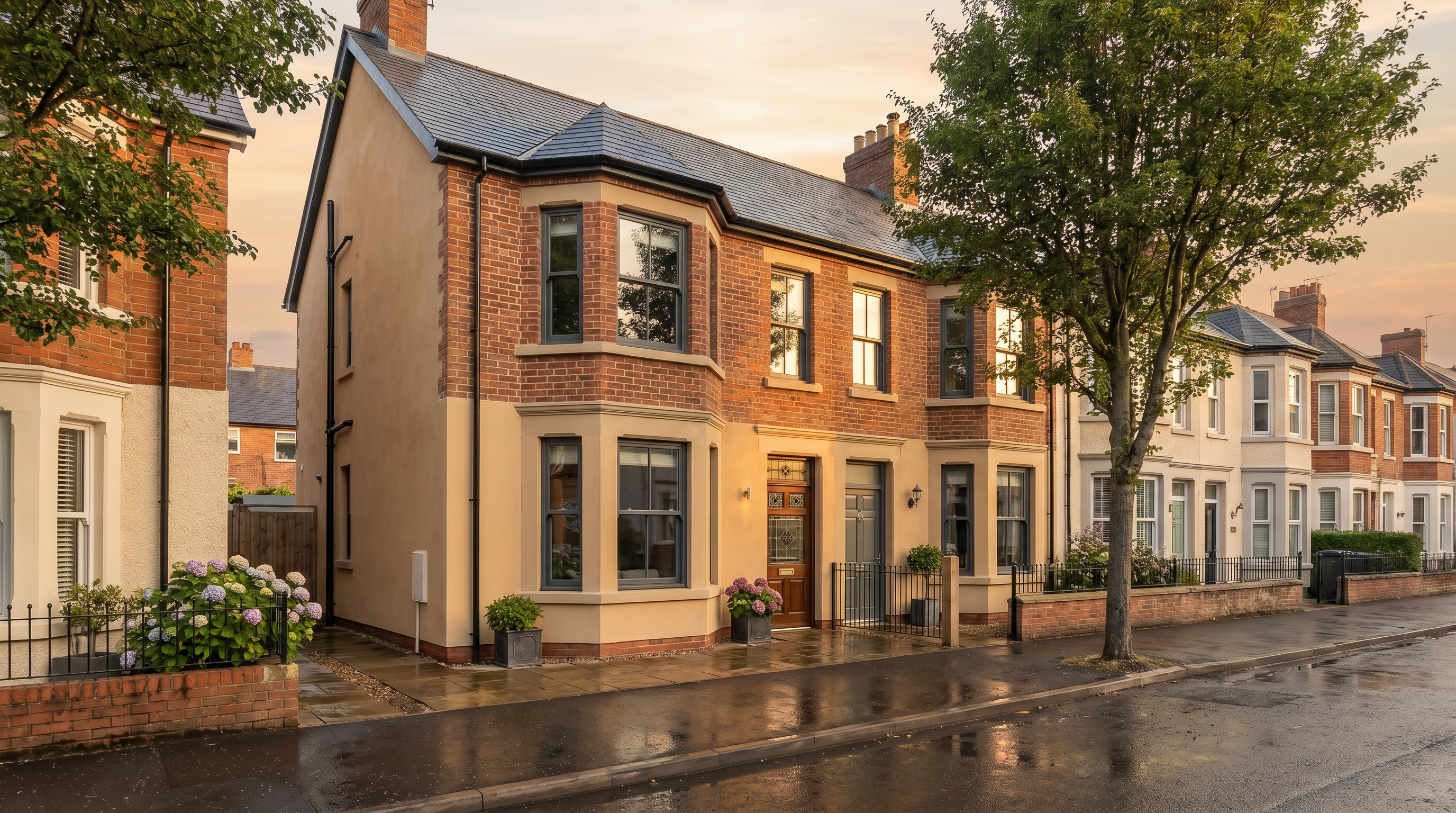
Victorian terraces are some of the most appealing homes in Britain, but they can also be some of the coldest. High ceilings, solid brick walls, suspended timber floors, and original windows all create character, yet they also create a house that is difficult and expensive to keep warm.
That often leaves owners asking the same questions. Why does the house feel cold even when the heating is on? Which insulation measures actually help? And how do you improve comfort without damaging the qualities that make a Victorian terrace worth owning in the first place?
This guide looks at the common heat-loss points, the best insulation routes, the planning and breathability issues that matter on period homes, and the practical order in which to tackle improvements.
Why Victorian terraces feel so cold.
The main problem is that these homes were built long before insulation standards existed. As a result, several parts of the building leak warmth at once, and the overall effect can feel much worse than any single issue on its own.
Solid walls
Most Victorian terraces have solid brick walls with no cavity. Heat passes through them readily, and in winter the internal wall surface can stay cold enough to make whole rooms feel uncomfortable even when the air is being heated.
Suspended timber floors
Original timber floors usually sit over a ventilated void. That allows cold air to move below the boards, while gaps in the floor can let draughts rise into the room above.
Sash windows and chimneys
Traditional sash windows and old chimney openings add more heat loss and more air leakage. They are part of the charm of the house, but they are rarely part of an efficient thermal envelope unless they are upgraded carefully.
High ceilings
The generous room proportions that make Victorian homes attractive also increase the volume of air you need to heat. Warm air rises, and that can make occupied areas lower down feel cool for longer.
The main insulation options.
Victorian terraces usually need a whole-house strategy rather than a single magic fix. Some measures are fast and inexpensive, while others are more transformative but demand more design care and budget.
Wall insulation
Walls are usually the biggest thermal problem, which is why wall insulation tends to make the biggest difference. On Victorian terraces, the choice is normally between external wall insulation and internal wall insulation.
- External wall insulation is usually the most effective thermally and avoids losing internal floor area.
- Internal wall insulation can preserve the exterior appearance, but it is more disruptive and needs careful moisture design.
- Where possible, many owners choose external insulation to the rear and a different solution, or no change, to the front elevation.
Floor insulation
Suspended floors can often be improved by insulating between joists or addressing draught paths. Even modest work here can make the house feel noticeably more comfortable underfoot.
Loft insulation
If the loft is under-insulated, this is often the quickest and cheapest worthwhile improvement. Victorian homes frequently benefit from a loft top-up before more expensive measures are considered.
Windows and draught-proofing
Original windows do not always need to be replaced to improve comfort. Secondary glazing, draught-proofing, and careful refurbishment can preserve character while delivering much better thermal performance than leaving them untreated.
External versus internal wall insulation on a Victorian terrace.
For many Victorian terraces, external wall insulation is the strongest overall answer where planning and street appearance allow it. It improves thermal performance substantially, avoids shrinking rooms, and reduces disruption inside the house. It can also refresh a tired exterior at the same time.
Internal wall insulation can still be the right choice where the facade must remain unchanged, but it comes with trade-offs. Rooms become slightly smaller, detailing around skirtings, sockets, and windows becomes more complicated, and poor specification can create moisture risks within the wall build-up.
That is why Victorian houses need more than a generic insulation quote. The property type, street context, and wall condition all matter when deciding which route is appropriate.
Why breathability matters on older solid-wall homes.
Victorian walls handle moisture differently from modern cavity construction. They need a sensible moisture strategy, which is why breathable specifications matter. Mineral wool insulation and breathable render systems are usually better aligned with the way older solid walls behave than less vapour-open alternatives.
This is especially important where there is already sensitivity around damp, condensation, or older masonry. A suitable system should improve comfort without trapping avoidable moisture problems inside the building fabric.
Planning permission and conservation concerns.
Some Victorian terraces can be insulated externally with relatively straightforward permissions, but others sit in conservation areas, have Article 4 restrictions, or form part of a very uniform street scene. In those cases, what is possible at the front of the house may differ from what is possible at the rear.
- Rear elevations are often more flexible than front elevations.
- Conservation areas and listed buildings need much more careful planning.
- Neighbouring houses and consistent street character can influence what is acceptable visually.
That means one of the most practical Victorian-terrace strategies is a partial approach, improving the areas where external insulation is possible and using different measures elsewhere.
A sensible order for improvements.
- Check and top up loft insulation if needed.
- Reduce draughts at windows, doors, floors, and unused chimneys.
- Improve floors where access and timing make it practical.
- Tackle wall insulation as the major thermal upgrade.
- Refine windows with secondary glazing or sympathetic upgrades where appropriate.
This sequence helps many owners capture easier wins first while building toward the measure that usually changes the house most significantly, namely the walls.
What costs should you expect?
Costs vary by terrace width, access, current condition, and how much of the house you are improving at once. Loft work and draught-proofing usually sit at the lower end, while full wall insulation is the biggest investment. End-of-terrace homes also tend to cost more because there is more exposed wall area to treat.
Even so, the cost should be weighed against the very real downside of leaving a Victorian terrace cold, expensive to heat, and uncomfortable year after year. On the right house, the improvement in comfort and running costs can be substantial.
End-of-terrace homes need extra attention.
End-of-terrace Victorian houses lose more heat because they have an extra exposed elevation, often the largest one. That usually makes wall insulation even more valuable, while also increasing project scope and budget compared with a mid-terrace property.
How to keep the character while improving the house.
A good Victorian retrofit should not try to erase the house’s identity. The aim is to make the property warmer and more usable while respecting the way it was built and the features that make it distinctive.
- Use breathable materials suited to solid-wall construction.
- Preserve original features where practical, especially windows and detailing.
- Choose finishes and colours that sit comfortably with the street.
- Work with installers who understand period buildings rather than treating them like generic modern houses.
What to do next if you own a Victorian terrace.
The best next step is a property-specific assessment. Victorian terraces vary more than people expect, and the right solution depends on wall condition, access, planning context, the state of the floors and windows, and how much change you are comfortable making externally.
A survey can show where heat is escaping most seriously, which measures should come first, and whether external wall insulation, partial external treatment, or another route makes the most sense for your particular house.
Keep researching this topic
Browse the wider archive before you make a decision.
Good blog content should narrow the question, not trap you on one page. Use the archive and category views to compare neighbouring guides, then move into service and proof pages once the direction becomes clearer.
Turn reading into the right next step
Use the advice, then move into the pages that answer your own property questions.
Educational content helps you understand the issue, but the next commercial step is usually to compare the most likely service, check proof from real homes, and then ask about your own property with confidence.
Compare the main insulation routes
Use the service pages to narrow whether external wall, cavity wall, or loft insulation looks like the strongest first route for your home.
Check real proof before deciding
Move from theory into before-and-after work, customer feedback, and project stories so the advice feels grounded in finished outcomes.
Ask about your own property
Once you understand the issue, the survey is the fastest way to turn general reading into a property-specific recommendation.
Explore the wider journey
Useful next pages once the article makes sense.
Rockwarm now has a fuller service, proof, FAQ, and local-search structure. These pages help move from general education into comparison, reassurance, and a more confident commercial next step.
Compare the three main insulation routes side by side before choosing the wrong first spend.
See longer-form proof showing how service choice, property type, and finished outcomes fit together.
Read homeowner feedback and trust signals.
Check coverage across Coventry, Nuneaton, Birmingham, and the wider Midlands.
Free survey
Ready to move from reading to a real recommendation?
Guides can explain the possibilities, but they cannot confirm exactly what your own property needs. If you want advice based on the actual walls, loft, layout, and condition of your home, book a free survey and we will point you toward the most suitable next step, including when a simpler route makes more sense than a larger project.