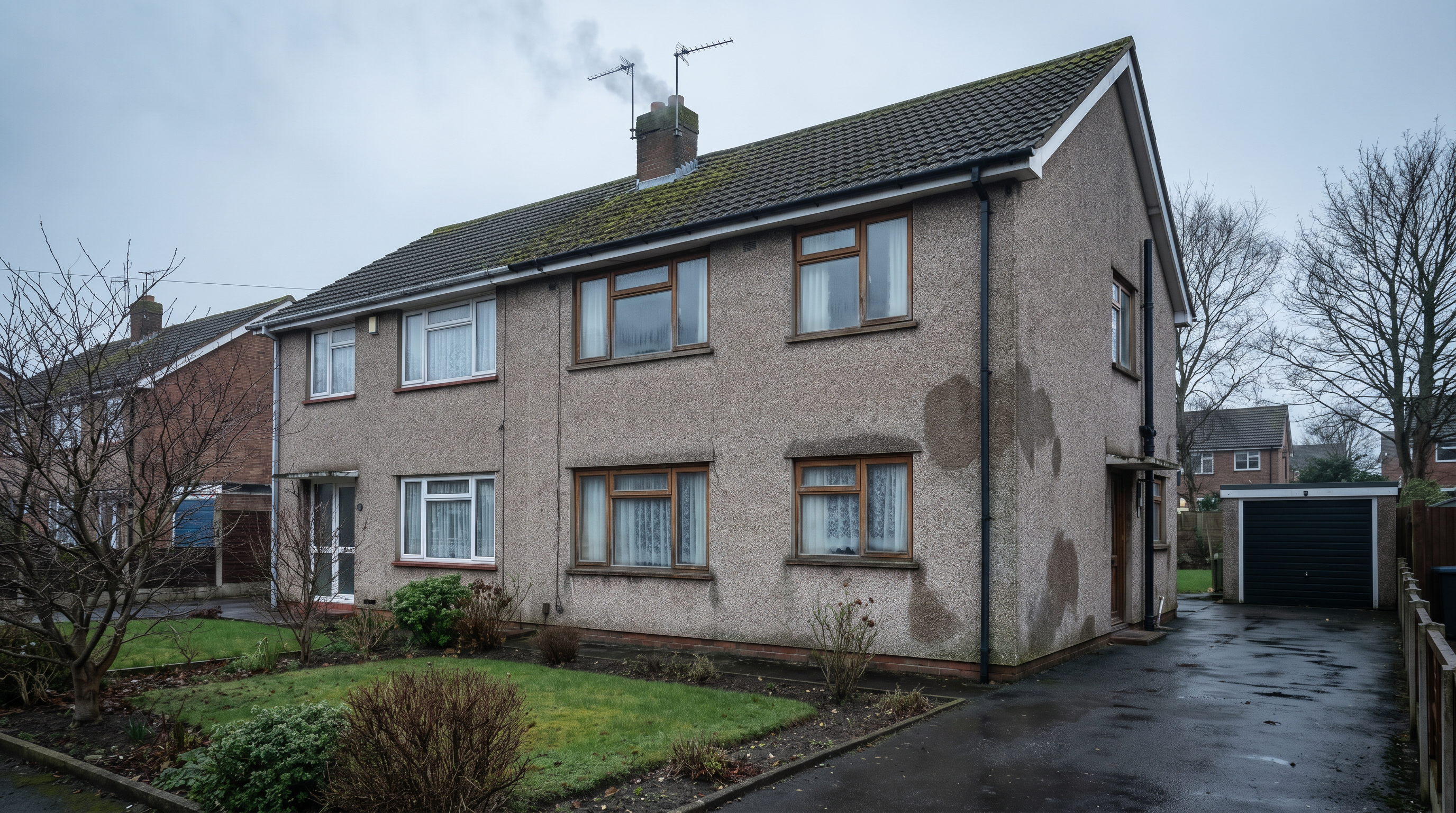
If you live in a home built between roughly 1945 and 1965, you probably know the feeling already. The house looks solid, the walls feel substantial, and yet the rooms never seem to hold warmth properly once the heating clicks off.
Many post-war properties are some of the coldest homes in Britain to heat well. The problem is not always the boiler, the thermostat, or how often the heating is used. Very often, it is the way the building was constructed and how poorly those walls perform by modern standards.
This matters because a cold post-war house rarely stays as just a comfort issue. It often turns into high bills, cold internal wall surfaces, condensation, and the kind of daily frustration that makes a home feel hard work for much of the year.
The post-war building rush created a thermal problem that still exists today.
After the Second World War, Britain needed homes quickly. Traditional building methods were not always fast enough to meet demand, so a huge number of houses were built using methods designed for speed, availability of materials, and practicality rather than long-term energy performance.
That meant thinner walls, concrete-based systems, steel framing, minimal insulation, and construction details that were acceptable for the time but leave homeowners with major thermal weaknesses today.
- Precast concrete panels and system-built walls
- Steel-framed homes with cladding or infill panels
- No-fines concrete construction
- Cavity walls with little or no insulation
- Prefabricated elements with joints that can become draughty over time
Why post-war homes feel colder than their appearance suggests.
The biggest misunderstanding with these houses is visual. A post-war property often looks substantial from the outside, so owners assume it should perform like a solid, dependable shell. In reality, many of these homes bleed heat surprisingly fast.
Thin or thermally weak walls
Concrete and steel are poor at keeping warmth inside a house. Concrete conducts heat, while steel can create severe cold bridges. If the wall build-up has little insulation value to begin with, the inside face of the wall can remain cold even when the room air is being heated.
Little or no insulation
A large proportion of post-war homes were never built with insulation levels anywhere near modern expectations. Some have empty cavities, some have no meaningful cavity at all, and some rely on construction systems where the wall itself offers very little thermal resistance.
Joints, gaps, and uneven performance
System-built and prefabricated homes often include joints, structural elements, or transitions that become weak points. Over time, these can contribute to draughts and uneven internal temperatures, particularly in exposed rooms.
Large areas of exposed external wall
Many post-war estates include homes with broad exposed elevations and simple layouts. That can mean more wall area losing heat and a greater difference between warmer internal air and colder wall surfaces.
Cold walls often lead directly to condensation and mould problems.
When internal wall surfaces stay cold, moisture in the air is more likely to condense onto them. That is why people in post-war homes often describe a pattern that looks like a ventilation problem alone but is actually tied to the building fabric as well.
- Windows stream with moisture on colder days
- Corners and external walls feel damp or smell musty
- Mould returns even after repeated cleaning
- North-facing rooms feel especially uncomfortable
- The heating runs but the house still feels chilly shortly afterwards
Ventilation still matters, of course, but homeowners often get trapped in partial solutions. They are told to wipe windows, open trickle vents, or heat the property more consistently, yet the underlying cold-wall issue is still there. If the fabric remains cold, symptoms often keep returning.
Why standard insulation advice does not always work on post-war homes.
A lot of generic retrofit advice assumes the house can be improved with straightforward cavity wall insulation. For many post-war homes, that is either unsuitable, impossible, or simply not the measure that addresses the real weakness.
Cavity wall insulation is not always the answer
Some homes have no cavity worth filling. Others have construction details that make cavity insulation a poor fit. In non-traditional housing, the wall system itself may be the problem rather than an empty cavity waiting to be upgraded.
Internal insulation can be disruptive
Insulating from the inside is possible in some cases, but it reduces room sizes, disrupts everyday living, affects sockets and skirtings, and often leaves junction details that are harder to solve cleanly. Many homeowners do not want that level of upheaval.
External wall insulation is often the most effective route for this type of property.
For many post-war and non-traditional homes, external wall insulation works because it tackles the problem where it actually exists: across the outside of the building envelope. Instead of trying to patch isolated weaknesses, it creates a continuous thermal layer around the external walls.
- It can work across many different post-war construction types
- It covers cold bridges and weak wall surfaces more continuously
- It helps internal wall surfaces become warmer and drier
- It improves comfort and reduces the speed at which heat escapes
- It can refresh the look of tired elevations with a new rendered finish
This is why external wall insulation is so often discussed in relation to 1950s and 1960s housing, concrete homes, and system-built estates. It is not just a cosmetic upgrade. In the right circumstances, it directly addresses the thermal weakness that causes the house to feel cold in the first place.
What a survey should assess on a post-war home.
Not every property should be treated in exactly the same way, which is why diagnosis matters. Before recommending a solution, a proper survey should establish what the house is made of, how the elevations are performing, whether there are signs of moisture-related problems, and what access or detailing constraints exist.
- Identify the construction type and the likely wall build-up.
- Check condition, access, and any areas that need repair before installation.
- Assess where condensation, cold bridging, or heat loss is most obvious.
- Explain whether external wall insulation, another route, or a staged approach is most sensible.
The result should be a warmer house, not just a prettier one.
Homeowners usually describe the best outcomes in very simple ways. The walls no longer feel icy. The house stays comfortable for longer. Heating feels more worthwhile. Problem rooms become usable. Condensation reduces because the internal surfaces are no longer so cold.
When the fabric improves, the whole house starts behaving differently. That is the real goal: not more heating input, but better thermal performance.
What to do next if your post-war house is hard to heat.
If your home is cold despite regular heating, if external walls feel cold to the touch, or if condensation and mould keep coming back, it is worth treating the house as a building-performance problem rather than a lifestyle problem. The right next step is to compare the likely insulation routes and then get advice on the actual property.
- Use the service pages to compare external wall, cavity wall, and loft insulation clearly.
- Use the FAQs if you are still weighing up objections or common concerns.
- Use the free survey if you want a recommendation based on your own walls, layout, and condition.
Post-war homes can absolutely be made warmer, more comfortable, and easier to live in. The key is to diagnose the construction properly and choose a measure that deals with the real source of the heat loss instead of just trying to compensate for it with more heating.
Keep researching this topic
Browse the wider archive before you make a decision.
Good blog content should narrow the question, not trap you on one page. Use the archive and category views to compare neighbouring guides, then move into service and proof pages once the direction becomes clearer.
Diagnose the problem, then compare the solution
Symptom-led articles are the start of the journey, not the end of it.
If you came here because the house feels uncomfortable, expensive to heat, or difficult to keep dry, the next step is to compare the likely insulation routes, see which problems each service is best suited to, and then ask for advice on the actual property.
Use the symptom-led comparison page
Follow the dedicated cold-wall and condensation route if you want a clearer bridge from symptoms into the most likely service options.
Compare the main services
Use the service hub to understand whether the problem points more strongly toward external wall, cavity wall, or loft insulation.
Ask about your own home
A survey is the right next step if you want to move from general symptoms into a property-specific recommendation without buying the wrong first fix.
Explore the wider journey
Useful next pages once the article makes sense.
Rockwarm now has a fuller service, proof, FAQ, and local-search structure. These pages help move from general education into comparison, reassurance, and a more confident commercial next step.
Compare the three main insulation routes side by side before choosing the wrong first spend.
See longer-form proof showing how service choice, property type, and finished outcomes fit together.
Read homeowner feedback and trust signals.
Check coverage across Coventry, Nuneaton, Birmingham, and the wider Midlands.
Free survey
Ready to move from reading to a real recommendation?
Guides can explain the possibilities, but they cannot confirm exactly what your own property needs. If you want advice based on the actual walls, loft, layout, and condition of your home, book a free survey and we will point you toward the most suitable next step, including when a simpler route makes more sense than a larger project.