If your home was built before the 1930s, there is a strong chance it has solid walls, and there is an equally strong chance those walls have little or no insulation. That is one reason so many older homes feel expensive to heat, slow to warm up, and uncomfortable in winter.
Solid walls can be insulated, but the route is different from a standard cavity-wall upgrade. You are not filling a gap in the wall. You are adding insulation either to the inside or to the outside, and each option comes with different costs, practical implications, and performance outcomes.
This guide explains what solid walls are, why they lose so much heat, how internal and external insulation compare, and why external wall insulation is often the better overall answer for homeowners who can use it.
What solid walls are and how to spot them.
Solid walls are usually made from a single continuous layer of brick, stone, or another masonry material. Unlike cavity walls, there is no built-in gap that can simply be filled with insulation. The wall is effectively one mass from inside to outside.
One clue is the age of the property. Homes built before 1920 are often solid wall, while properties from the 1920s and early 1930s can be a mixture. Another clue is the brick pattern. If you can see both the long face and the short end of bricks in the external wall, that often points to solid-wall construction.
- A wall thickness under roughly 260mm often suggests solid-wall construction.
- Mixed construction is common on older homes, so some parts of the house may behave differently from others.
- A proper survey is the safest way to confirm what the house is actually made of.
Why solid walls lose so much heat.
Solid brick or stone walls are far worse thermally than a modern insulated wall. Heat passes through them much more easily, which means the inner wall surface often stays noticeably colder than the room air during winter. That is why old solid-wall houses can feel chilly even when the heating is on.
The consequence is not only higher energy use. Colder wall surfaces can also make condensation more likely, especially in rooms with everyday moisture loads such as kitchens, bathrooms, and occupied bedrooms. In other words, the wall is often part of the comfort problem and part of the moisture problem at the same time.
Your two main options: internal or external.
Because there is no cavity to fill, solid-wall insulation normally means adding insulation to one face of the wall or the other. Internal wall insulation places insulation on the inside of external walls. External wall insulation wraps the house from the outside and then finishes it with a protective render system.
Both routes can work. The important question is not whether either option works in theory, but which one suits the property, your priorities, and the level of disruption you are willing to take on.
Internal wall insulation: where it helps and where it struggles.
Internal wall insulation is often considered where the outside of the building cannot be altered, such as listed buildings, conservation constraints, or projects where preserving the original facade is essential. It can also be phased room by room, which appeals to some households trying to spread cost over time.
The difficulty is that it is highly disruptive. Rooms need to be cleared, sockets and radiators often need repositioning, skirtings and reveals need reworking, and every treated room then needs finishing again. You also lose a small amount of internal floor area, which can be very noticeable in tighter rooms.
- Lower upfront cost can make internal insulation look attractive.
- It keeps the outside appearance unchanged.
- It can be a sensible fallback where external insulation is not permitted.
- It leaves more risk around junctions, cold bridges, and moisture detailing if poorly designed.
External wall insulation: why it is often the stronger route.
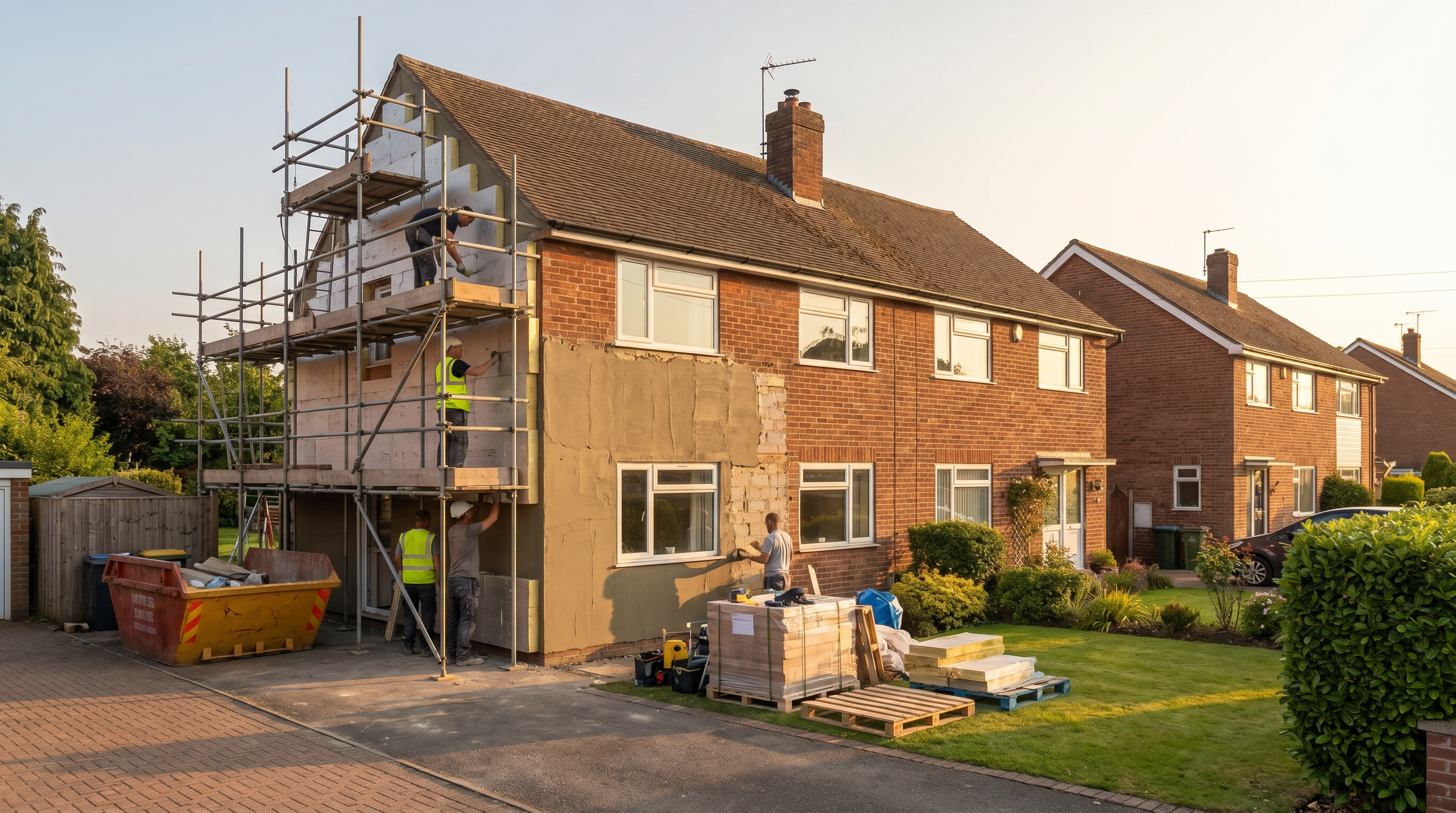
External wall insulation usually gives the most complete result because it improves the building envelope from the outside rather than trying to retrofit one room at a time from within. It keeps the walls warmer, reduces cold bridging more effectively, protects the underlying masonry, and avoids shrinking your rooms.
For many owners, the practical advantage is just as important as the thermal one. The work is mainly external, so day-to-day life inside the house is far less disrupted. At the same time, the property gets a new rendered finish, which can transform a tired exterior and make the whole home look better maintained.
- No loss of room size because the insulation sits outside the house.
- Far less internal disruption during installation.
- Better continuity across junctions and weak points in the building envelope.
- A refreshed external finish can improve appearance as well as comfort.
A simple head-to-head comparison.
- Internal insulation is usually cheaper upfront, but much more disruptive internally.
- External insulation usually costs more, but it protects room sizes and treats the building more comprehensively.
- Internal insulation is often chosen because it is the only acceptable route, not because it is the best-performing one.
- External insulation is often the preferred route where planning, budget, and site conditions allow it.
What about costs and payback?
Solid-wall insulation is a meaningful investment, which is why homeowners usually ask about the numbers early. Internal systems may come in lower on headline cost, while external systems tend to sit higher because they involve scaffolding, full envelope treatment, and a finished render system.
That said, the comparison should not stop at installation price. A colder solid-wall home can waste a huge amount of heat year after year, and that ongoing cost shows up in bills, comfort, condensation risk, and long-term building wear. For many owners planning to stay in the property, the stronger performance of an external system is what makes the investment make sense.
When internal insulation still makes sense.
There are absolutely cases where internal insulation is the right answer. If the external appearance must remain unchanged, if planning restrictions make outside treatment unrealistic, or if only a very limited area is being improved, then internal solutions can be appropriate. The point is not that internal insulation is wrong. It is that it comes with more compromises and needs better detailing to avoid unintended problems.
Our practical recommendation.
For most solid-wall homes where external work is allowed, external wall insulation is the stronger overall solution. It tends to deliver better thermal continuity, less disruption, no loss of room size, and a more complete long-term upgrade to the building envelope.
Internal insulation remains important in more constrained situations, but when homeowners genuinely have a choice, external wall insulation is usually the route that solves the cold-wall problem more thoroughly and more comfortably.
What to do next if you think your home has solid walls.
The next step is to confirm the wall construction and assess which approach fits the property. Older homes vary more than people expect, and success depends on the details: wall type, condition, moisture behaviour, access, planning context, and how much change is acceptable externally.
A proper survey can show whether external wall insulation is suitable, whether internal insulation needs to be considered instead, and which route is most likely to improve comfort, reduce bills, and protect the building over the long term.
Keep researching this topic
Browse the wider archive before you make a decision.
Good blog content should narrow the question, not trap you on one page. Use the archive and category views to compare neighbouring guides, then move into service and proof pages once the direction becomes clearer.
Turn reading into the right next step
Use the advice, then move into the pages that answer your own property questions.
Educational content helps you understand the issue, but the next commercial step is usually to compare the most likely service, check proof from real homes, and then ask about your own property with confidence.
Compare the main insulation routes
Use the service pages to narrow whether external wall, cavity wall, or loft insulation looks like the strongest first route for your home.
Check real proof before deciding
Move from theory into before-and-after work, customer feedback, and project stories so the advice feels grounded in finished outcomes.
Ask about your own property
Once you understand the issue, the survey is the fastest way to turn general reading into a property-specific recommendation.
Explore the wider journey
Useful next pages once the article makes sense.
Rockwarm now has a fuller service, proof, FAQ, and local-search structure. These pages help move from general education into comparison, reassurance, and a more confident commercial next step.
Compare the three main insulation routes side by side before choosing the wrong first spend.
See longer-form proof showing how service choice, property type, and finished outcomes fit together.
Read homeowner feedback and trust signals.
Check coverage across Coventry, Nuneaton, Birmingham, and the wider Midlands.
Free survey
Ready to move from reading to a real recommendation?
Guides can explain the possibilities, but they cannot confirm exactly what your own property needs. If you want advice based on the actual walls, loft, layout, and condition of your home, book a free survey and we will point you toward the most suitable next step, including when a simpler route makes more sense than a larger project.