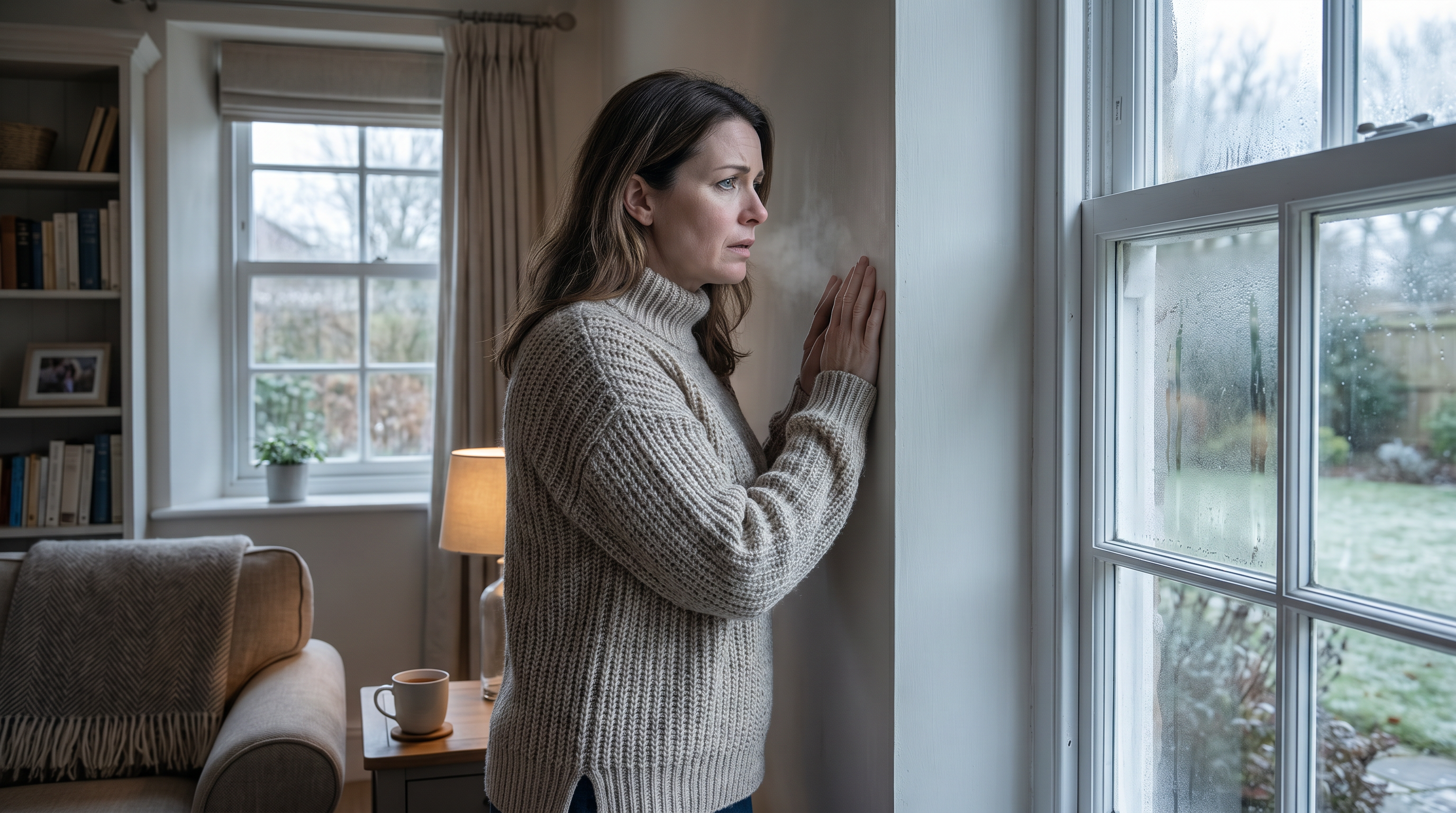
If the heating has been running for hours and your external walls still feel freezing to the touch, the problem usually is not your thermostat. It is often the wall itself.
Older homes across the Midlands frequently lose heat through uninsulated walls, which leaves rooms uncomfortable, drives up heating bills, and creates the kind of cold internal surfaces that lead directly to condensation and mould.
A wall that feels icy from the inside is not just unpleasant. It is a sign that warmth is escaping through the building fabric faster than the house can hold onto it.
Why walls stay cold even when the room air is warm.
In many older properties, especially solid-wall homes and houses with poor thermal performance, the heated air in the room warms up more quickly than the wall surface. That means you can technically reach the temperature set on the thermostat while the room still feels uncomfortable to live in.
The reason is simple. Heat is moving through the wall and escaping outside. The wall never stores enough warmth to feel comfortable, so the room can feel cold and uneven even when the heating is on.
Why some walls feel colder than others.
- North-facing walls usually get less solar warmth and can stay colder throughout the day.
- End-of-terrace and detached homes have more exposed wall area losing heat.
- Rooms beside garages, side passages, or unheated spaces often feel colder because adjacent areas offer little retained warmth.
- Older solid-wall construction and thermally weak wall types often allow heat to pass through far faster than modern insulated walls.
This is why one bedroom or one elevation can feel permanently uncomfortable while the rest of the house feels merely average. The pattern usually follows the coldest exposed walls, not the rooms you happen to notice first.
Cold walls create more than a comfort problem.
Once wall surfaces stay cold, the issue spreads into other day-to-day problems. That is why homeowners often start by complaining about mould, damp patches, or window condensation without realising all of them can be linked back to the same thermal weakness.
Condensation
Warm moist indoor air turns into water when it hits a sufficiently cold surface. That is why windows stream, corners feel damp, and external wall surfaces become clammy during colder weather.
Mould
Mould needs persistent moisture. Cold walls supply it through repeated condensation, which is why cleaning mould away rarely fixes the problem for long if the wall surface remains cold.
High heating bills
When the house leaks heat through the walls, the heating system has to work harder and more often. Homeowners end up paying more for a standard of comfort they still do not feel they are getting.
Cold air movement near the floor
Air cooled by the wall drops and moves across the room, which is why some homes feel draughty even where there is no obvious gap around doors or windows.
What usually does not solve the problem.
- Turning the heating up only adds more heat to a wall that is still losing it.
- Adding radiators does not fix the thermal weakness in the wall construction.
- Anti-mould paint and cleaning products deal with symptoms rather than the cause.
- Dehumidifiers and extra ventilation can help manage moisture but cannot make a cold wall perform like an insulated one.
These measures can sometimes reduce the visible symptoms for a while, but they rarely deliver a lasting improvement if the real problem is uninsulated or poorly performing external walls.
The real fix is to make the wall warmer.
For solid-wall and hard-to-heat homes, wall insulation is usually the measure that changes the situation most dramatically because it addresses the route the heat is taking out of the building.
Internal wall insulation
Internal insulation can help in some properties, but it reduces room sizes, creates disruption inside lived-in spaces, and often involves moving radiators, skirtings, and sockets.
External wall insulation
External wall insulation adds a continuous layer around the outside of the home, helping internal wall surfaces stay warmer while also refreshing the appearance of the property. For many older homes, it is the cleaner and more comprehensive solution.
What changes when the walls are insulated properly.
- Walls feel warmer to the touch instead of icy.
- Condensation is less likely because surfaces stay warmer.
- Rooms hold heat for longer after the heating switches off.
- Problem rooms become more usable and more comfortable.
- Heating feels more effective because the house is not losing warmth as quickly.
This is why homeowners often describe the result in very simple terms: the house just feels different. Not slightly improved, but calmer, warmer, and easier to live in during cold weather.
How to tell if this is your issue.
- Your external walls feel cold even after the heating has been on.
- Some rooms never seem to warm up properly.
- You notice condensation on windows or damp patches on outside-facing walls.
- Mould keeps returning after cleaning.
- Your home feels expensive to heat for the comfort level you actually get.
If several of those points sound familiar, it is worth treating the issue as a wall-performance problem rather than assuming it is only about ventilation or heating habits.
What to do next.
The best next step is a proper survey that confirms the wall type, checks suitability, and explains whether external wall insulation, cavity wall insulation, loft insulation, or a staged improvement plan makes the most sense for your home. Diagnosis comes first, because the right recommendation depends on the actual construction.
If your walls are stone cold, you do not have to keep treating the symptoms forever. The priority is to identify why those surfaces are so cold and then improve the part of the house that is really letting the warmth out.
Keep researching this topic
Browse the wider archive before you make a decision.
Good blog content should narrow the question, not trap you on one page. Use the archive and category views to compare neighbouring guides, then move into service and proof pages once the direction becomes clearer.
Diagnose the problem, then compare the solution
Symptom-led articles are the start of the journey, not the end of it.
If you came here because the house feels uncomfortable, expensive to heat, or difficult to keep dry, the next step is to compare the likely insulation routes, see which problems each service is best suited to, and then ask for advice on the actual property.
Use the symptom-led comparison page
Follow the dedicated cold-wall and condensation route if you want a clearer bridge from symptoms into the most likely service options.
Compare the main services
Use the service hub to understand whether the problem points more strongly toward external wall, cavity wall, or loft insulation.
Ask about your own home
A survey is the right next step if you want to move from general symptoms into a property-specific recommendation without buying the wrong first fix.
Explore the wider journey
Useful next pages once the article makes sense.
Rockwarm now has a fuller service, proof, FAQ, and local-search structure. These pages help move from general education into comparison, reassurance, and a more confident commercial next step.
Compare the three main insulation routes side by side before choosing the wrong first spend.
See longer-form proof showing how service choice, property type, and finished outcomes fit together.
Read homeowner feedback and trust signals.
Check coverage across Coventry, Nuneaton, Birmingham, and the wider Midlands.
Free survey
Ready to move from reading to a real recommendation?
Guides can explain the possibilities, but they cannot confirm exactly what your own property needs. If you want advice based on the actual walls, loft, layout, and condition of your home, book a free survey and we will point you toward the most suitable next step, including when a simpler route makes more sense than a larger project.