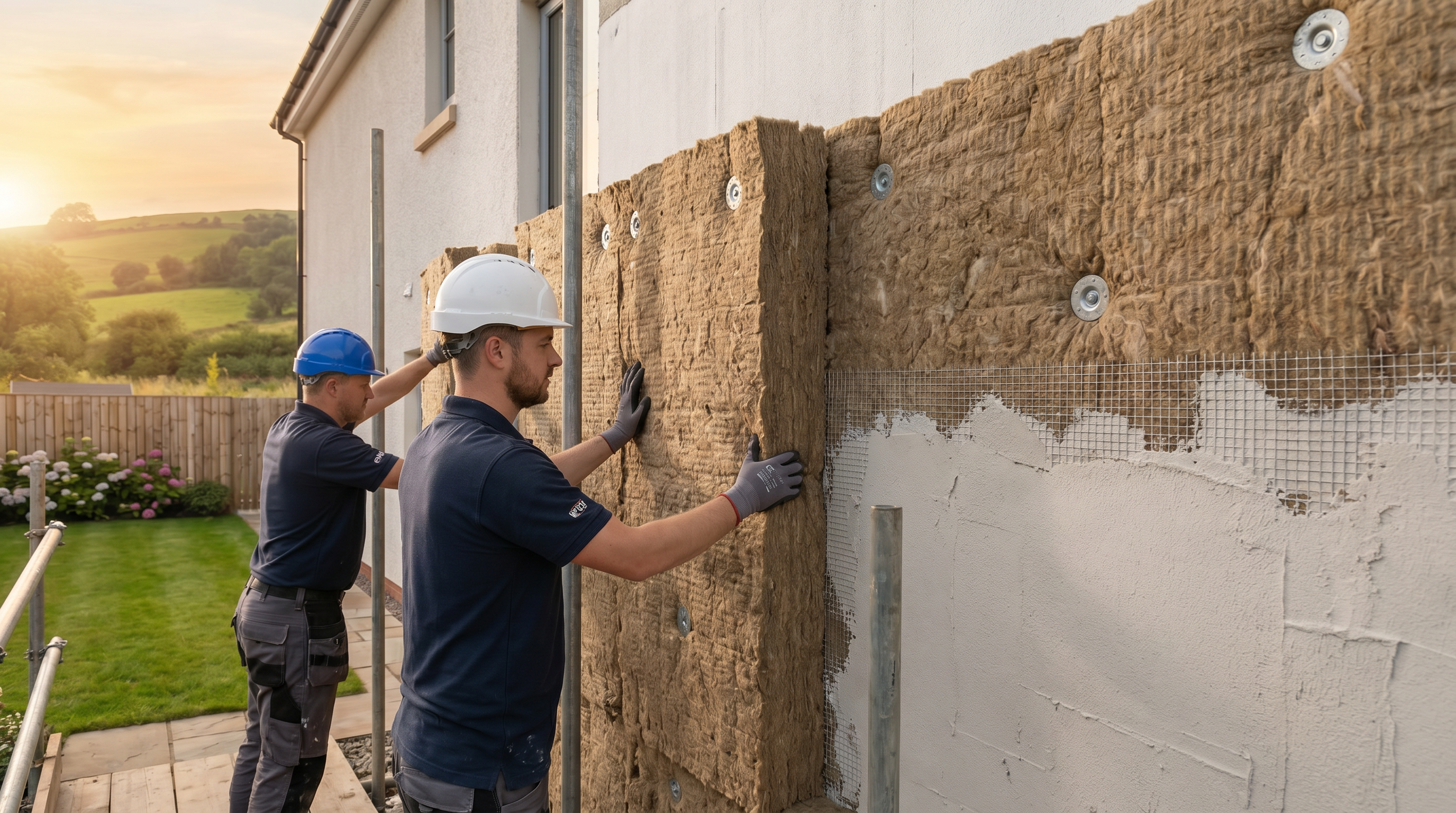
When external wall insulation quotes come back at very different prices, one of the biggest reasons is often hidden inside the specification: the insulation material itself. To most homeowners, the job sounds the same either way. In practice, the choice between Rockwool and polystyrene can change how suitable the system is for the building.
Both materials are used widely. Both can insulate. The important question is not whether one is universally good and the other universally bad. The better question is which material makes more sense for the kind of homes Rockwarm usually works on, especially older solid-wall properties across the Midlands.
That is why Rockwarm uses Rockwool mineral wool rather than EPS polystyrene as its standard route. It costs more, but for the homes we typically survey, it solves more of the right problems and carries fewer compromises.
What is the difference between Rockwool and polystyrene?
EPS polystyrene is a lightweight foam board made from expanded beads. It is familiar, inexpensive, and thermally effective for many applications. Rockwool, by contrast, is a mineral wool or stone wool product made from rock spun into dense fibres and formed into rigid boards suitable for external wall insulation systems.
The key point is that these materials do not behave the same way. They differ not only in cost, but also in breathability, fire performance, acoustic behaviour, and how well they match older building fabric.
Why Rockwool makes more sense on older solid-wall homes.
Breathability
This is the biggest reason. Older solid-wall homes manage moisture differently from more modern cavity-wall construction. They rely much more on the building fabric being able to deal with vapour movement sensibly over time. Rockwool is breathable, which means it is much better aligned with that type of construction.
- Rockwool allows vapour movement more naturally through the system.
- Polystyrene is far less breathable and can create a less forgiving setup on older solid-wall properties.
- That matters where damp sensitivity, wall condition, and moisture management are already part of the building story.
Fire safety
Rockwool is non-combustible and carries a much stronger fire-performance profile than EPS. For homeowners, that translates into peace of mind as well as a more robust specification. Polystyrene products may include fire-retardant treatment, but they remain combustible materials.
Acoustic performance
Rockwool also absorbs sound far better than polystyrene. That means the improvement is not only about heat loss. On busy roads or in noisier neighbourhoods, homeowners often notice the house feels calmer as well as warmer.
Long-term reliability
Mineral-based insulation has a strong reputation for long-term stability. A well-specified Rockwool system is valued not just for immediate performance, but for durability and confidence over the lifespan of the installation.
Why some installers still choose polystyrene.
There are understandable reasons. EPS is cheaper, lighter, widely available, and thermally effective. For some newer properties, some constrained budgets, and many grant-led installations, it can be an economically convenient option.
- It reduces upfront material cost.
- It is lighter to handle on site.
- It is often easier to make scheme or budget economics work with EPS.
That does not make it the right default for every house. It simply explains why quotes can differ and why a lower price can sometimes reflect a very different specification rather than better value.
What this difference looks like in real houses.
On a Victorian terrace, Edwardian semi, or older solid-wall Midlands house, Rockwool is usually the more forgiving and more appropriate system choice. It respects the way the wall behaves, improves thermal performance, strengthens fire confidence, and adds acoustic benefit at the same time.
On a much newer property with different construction and a tighter budget, EPS may be a more arguable option. That is why good installers should explain not just what they use, but why they use it for that building type.
The cost difference and why Rockwarm accepts it.
Rockwool does cost more. The boards are more expensive, the system is heavier, and the job can require a more robust overall approach. But cost on its own is not the right decision-maker. The better question is whether the added cost buys a more suitable and safer solution for the type of property being insulated.
For many homes Rockwarm works on, the answer is yes. The premium is part of a specification designed around older solid-wall performance rather than the cheapest route that still counts as insulation.
Questions to ask when comparing quotes.
- Ask exactly what insulation board is being quoted.
- Ask why that material is being used on your specific property type.
- Ask whether the system is intended for older solid-wall moisture behaviour or just minimum thermal compliance.
- Ask what render and full system specification sit around the insulation choice.
- Ask what trade-offs are being made to achieve a lower headline price.
If an installer cannot explain the reasoning behind the material choice, that is usually a warning sign. Specification should be deliberate, not vague.
How grant schemes influence material choice.
This article also links directly to the grants conversation. Scheme-funded work often pushes installers toward lower-cost material choices that keep the numbers workable under programme rules. That is one reason grant-backed and private installations can look similar from the outside while being meaningfully different in specification.
If you are paying privately, you have more freedom to ask for a system that fits the building rather than a system that fits the scheme economics.
Why Rockwarm uses Rockwool as standard.
Rockwarm works on many older Midlands homes where solid walls, breathability, comfort problems, and long-term fabric performance all matter. In that context, Rockwool aligns better with the type of property and the quality standard the business wants to deliver.
- It is more appropriate for older solid-wall construction.
- It offers stronger fire and acoustic performance.
- It supports a premium long-term specification rather than a budget minimum.
That does not mean every property in Britain must use Rockwool. It means Rockwarm has made a deliberate material choice for the homes it specialises in and is willing to explain that choice transparently.
What to do next if you are comparing systems.
The best next step is to compare full specifications rather than prices in isolation. Look at the insulation type, render system, suitability for the wall construction, and the reasoning behind the recommendation. That is where the difference between a cheap quote and a good quote becomes clear.
If you want a recommendation based on your actual walls rather than a generic assumption, book a survey and compare the options with the building in front of you. Material choice only makes sense when it is tied to the property properly.
Keep researching this topic
Browse the wider archive before you make a decision.
Good blog content should narrow the question, not trap you on one page. Use the archive and category views to compare neighbouring guides, then move into service and proof pages once the direction becomes clearer.
After cost research, compare the real routes
Do not stop at price ranges. Use the service, proof, and survey pages to work out what is actually right for your house.
Cost-led readers are usually close to making a decision. The most helpful next step is to compare services clearly, then validate the likely route against real work and a property-specific survey.
Visit the external wall service page
If your questions are mainly about solid walls, rendering, finish, and deeper retrofit value, start here.
Check proof before you commit
Use real project pages to understand what finished work looks like and how homeowners judge the result beyond price alone.
Get a survey for your own property
The real answer depends on wall type, access, detailing, and what already exists on the house. The survey turns research into an informed decision.
Explore the wider journey
Useful next pages once the article makes sense.
Rockwarm now has a fuller service, proof, FAQ, and local-search structure. These pages help move from general education into comparison, reassurance, and a more confident commercial next step.
Compare the three main insulation routes side by side before choosing the wrong first spend.
See longer-form proof showing how service choice, property type, and finished outcomes fit together.
Read homeowner feedback and trust signals.
Check coverage across Coventry, Nuneaton, Birmingham, and the wider Midlands.
Free survey
Ready to move from reading to a real recommendation?
Guides can explain the possibilities, but they cannot confirm exactly what your own property needs. If you want advice based on the actual walls, loft, layout, and condition of your home, book a free survey and we will point you toward the most suitable next step, including when a simpler route makes more sense than a larger project.