Silicone render
A modern, flexible, water-repellent finish often chosen for clean appearance and lower maintenance.
Best for: Homeowners wanting a smart finish with strong weather resistance.
House rendering gives external walls a protective new finish and can transform the way a property looks. For cold, older or solid-wall homes, it is also the point where many homeowners need clear advice about whether render-only work is enough, or whether external wall insulation with render would be the better long-term upgrade.
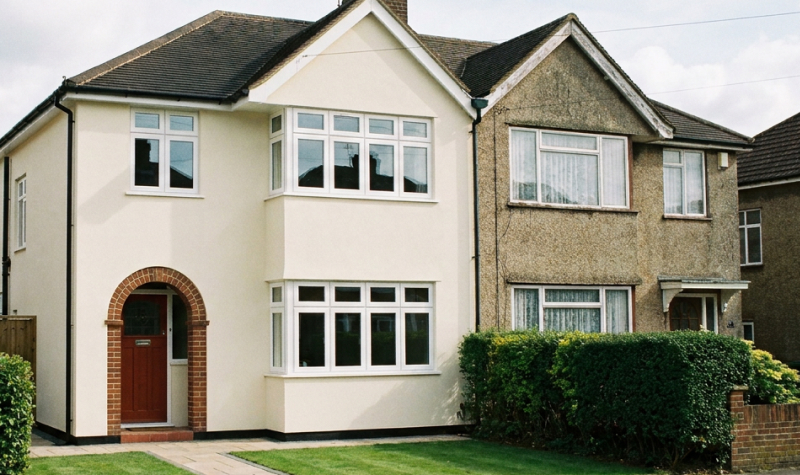
House rendering is the process of applying a protective coating to the outside walls of a property. The render sits over masonry, blockwork, existing prepared surfaces, or an external wall insulation system, creating a finished exterior that can look cleaner, sharper, and more weather-resistant.
In simple terms, rendering changes the outside surface of the house. It can help protect the wall and improve kerb appeal, but render by itself is not the same as insulating the property. If cold walls, heat loss, or condensation are the bigger problems, the better question is whether your home needs external wall insulation finished with render.
There is no single best render for every property. A good recommendation depends on the existing wall, exposure, desired appearance, maintenance expectations, and whether the work is part of a full insulation system.
A modern, flexible, water-repellent finish often chosen for clean appearance and lower maintenance.
Best for: Homeowners wanting a smart finish with strong weather resistance.
A through-coloured render that can create a textured finish and is often used for larger exterior refreshes.
Best for: Properties where a robust one-coat style finish suits the look of the home.
System-based finishes that may be specified where breathability, colour, or technical performance matters.
Best for: Projects where the wall build-up and manufacturer system need to be considered carefully.
An older style of render that can suit some properties but may not offer the flexibility of modern systems.
Best for: Limited repair situations where the existing construction and finish make it appropriate.
A reinforced render finish applied over external wall insulation boards as part of a full thermal upgrade.
Best for: Cold solid-wall homes where comfort and energy performance matter as much as appearance.
Online rendering prices can only ever be a guide because the visible finish is just one part of the work. A reliable quote needs to account for preparation, access, scaffolding, wall condition, details around windows and rooflines, and the chosen render system.
Rockwarm gives survey-led advice rather than pushing a generic price. This is especially important where the existing surface is cracked, old pebbledash is failing, damp is suspected, or the homeowner may get better value from external wall insulation with a rendered finish.
Read the EWI cost guideMany homeowners start by asking about render because the outside of the house looks tired. The right answer depends on whether the problem is only cosmetic, or whether the walls are also cold, damp-prone, or expensive to heat.
A good rendering job depends on preparation and detailing. The finished surface is what you see, but the long-term result depends on the work underneath.
The first step is understanding the wall type, existing surface, access, moisture risks, and whether the project should be render-only or include insulation.
Loose material, cracked areas, failed old render, awkward details, and weak surfaces need attention before a lasting finish can be installed.
Modern render systems rely on correct beads, mesh, reinforcement, trims, and detailing around openings rather than simply covering the wall.
The final render finish is applied in suitable weather conditions, then checked and handed over with practical care advice.
Rockwarm helps homeowners across Nuneaton, Coventry, Birmingham, Warwickshire, Leicestershire, and the wider Midlands understand the right route for their property. If you are unsure whether your home needs render repair, a modern silicone finish, or external wall insulation with render, a survey gives you a clearer answer.
These are the questions homeowners usually ask when they are deciding whether to repair old render, refresh the outside of the property, or combine rendering with external wall insulation.
House rendering is the process of applying a protective finish to the outside walls of a property. It can improve the appearance of tired brickwork or blockwork, help protect the wall from weather, and create a cleaner, more modern exterior finish.
Render on its own is mainly a protective and decorative finish, not a full insulation upgrade. If warmth, high energy bills, or cold solid walls are the main concern, external wall insulation with a rendered finish is usually the stronger route to consider.
The cost of rendering a house depends on wall area, access, scaffolding, the condition of the existing surface, detailing around windows and rooflines, and the chosen render system. Rockwarm recommends a property survey before relying on any online price range.
Rendering changes and protects the outside surface of the wall. External wall insulation adds insulation boards to the outside of the property before applying a reinforced render finish, so it improves thermal performance as well as appearance.
The best finish depends on the property, the condition of the walls, the level of weather exposure, the look you want, and whether the project includes insulation. Modern silicone render systems are popular for low maintenance and flexibility, while other finishes may suit particular homes or planning requirements.
Book your free survey. No obligation, no pressure — just an honest assessment of the best insulation approach for your home, along with clear advice and a fixed-price quote where appropriate.
